My first text-to-SQL RAG pipeline
Author's note: This post was adapted from a presentation at the Recurse Center. If you prefer to explore hands-on first, the interactive app can be found here.
Suppose we have a text-to-SQL agent [1] and the Titanic dataset in our relational database [2]. To the input text "Number of passengers", a reasonable response from the agent is something like "SELECT COUNT(*) FROM passengers".
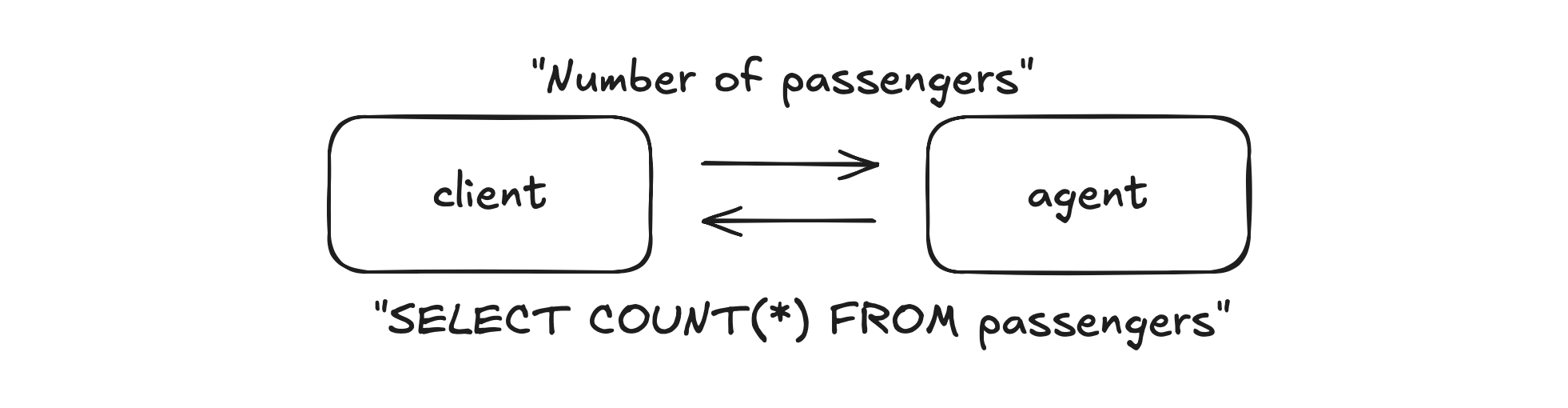
If the table name is dim_passengers, however, the query should be "SELECT COUNT(*) FROM dim_passengers". Let’s take this a step further. What if we want only the passengers above the age of 21? How does the agent know the column to filter on is age, passenger_age, or something else?
To provide the necessary context to the agent, we’ll need to add a separate step to retrieve that context, and augment the generation by sharing that context alongside the input text. This is commonly referred to as retrieval-augmented generation, or RAG.
Set up
First, we load up the vector database with the table metadata. The table metadata for dim_passengers could look like this (full table metadata and sample rows here).
{
    "table_name": "dim_passengers",
    "columns": [
        {
            "column_name": "passenger_id",
            "column_type": "int",
            "column_description": "Unique identifier for each passenger",
        },

        {
            "column_name": "age",
            "column_type": "float",
            "column_description": "Age of the passenger in years",
        },
        ...
}
Next we convert the table metadata into vector embeddings, which are numerical representations of text that capture semantic meaning in a high-dimensional space. We use OpenAI’s text-embedding-3-small model, and end up with three vectors each of length 1,536.
    {
        "table_name":
            "dim_passengers",
        ...
    }

    {
        "table_name":
            "dim_tickets",
        ...
    }

    {
        "table_name":
            "dim_ports",
        ...
    }
# dim_passengers
[-0.027, -0.023, 0.047, ...]


# dim_tickets
[-0.068, -0.042, 0.048, ...]


# dim_ports
[-0.028, -0.004, 0.047, ...]
We then store the table metadata-vector pairs in the vector database.
Retrieval
Next, we figure out which table to send to the agent. To do this we convert the input text itself to a vector embedding, and calculate the distance between the input text vector and each of the three table metadata vectors [3]. For simplicity, we select the closest one.
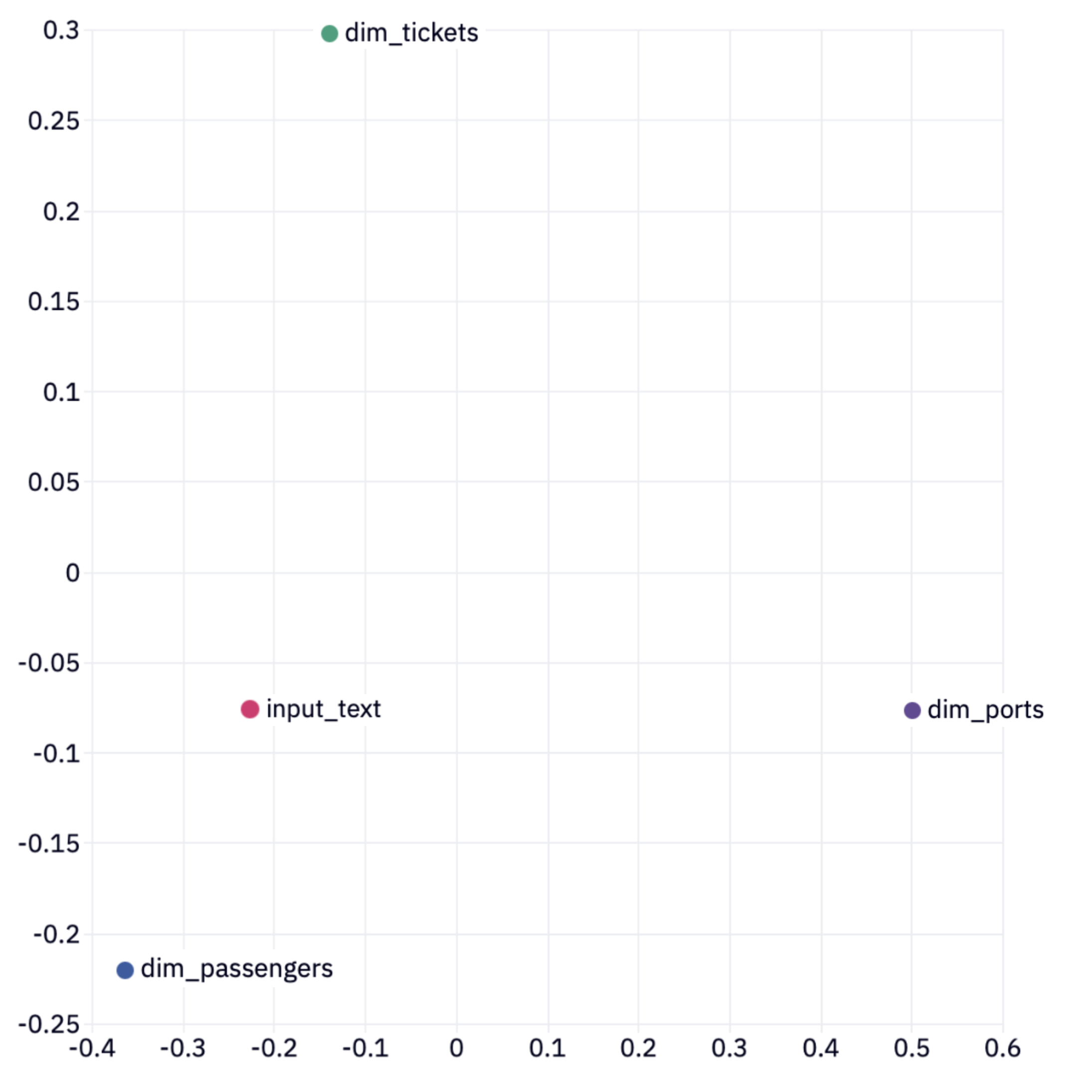
For ease of visualization, the chart shows all vectors projected to a 2-dimensional space [4]. We can easily see that dim_passengers is the semantically closest table to the input text [5].
Generation
Finally, we send the table metadata alongside the input text to the agent.
[
    {
        "role": "system",
        "content": f"""\
You are a world-class data analyst. Please respond with SQL that answers the
user request.

The tables in descending order of relevance are: {tables}""",
    },
    {
        "role": "user",
        "content": input_text,
    },
]
To wrap up, the agent usually needs a bit of help to generate the relevant query. This is done by augmenting the generation with additional context from the retrieval stage.
Next steps
Feel free to try this out on Hex here! The code can be found on Github here.
If this sounds like fun, you should apply to Recurse Center! The next batch starts on November 4, 2024.
If you’re curious about my take, I’m reachable here. Other RC posts can be found here and here.
[1] For our purposes, an agent is an LLM configured for a specific task typically using a pre-defined prompt prefix. For example, a text-to-SQL agent might have the prefix "Convert the following text to SQL" guiding its responses.
[2] The Titanic dataset has a special place in my heart. My very first workshop involves building a Random Forest classification model on top of the dataset.
[3] Calculating the distance against all points is impractical in general. Vector databases can have query time complexity as low as O(log n), by dividing up the space to speed up nearest neighbor search.
[4] Principal Component Analysis (PCA) was used to project high-dimensional embeddings into a 2-dimensional space.
[5] Euclidean distance is used since it’s easier to make out in the 2-dimensional projection, but cosine distance is an excellent candidate as it accounts for direction in a high-dimensional space rather than magnitude.